Data and AI governance / Detakai field note
Unity Catalog makes governance the platform's job
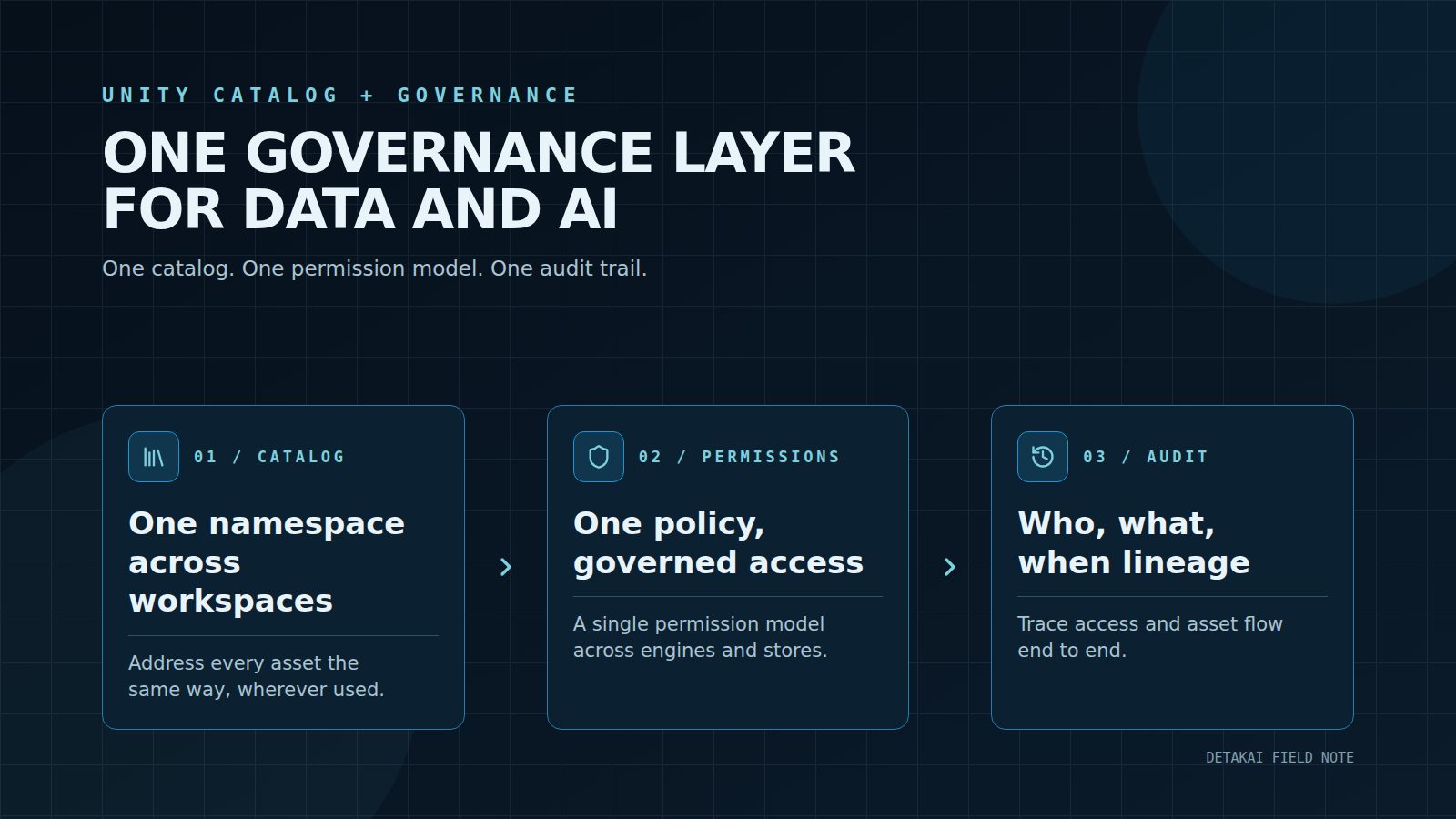
Unity Catalog turns governance into a shared platform capability: one catalog, one permission model, and audit for data and AI assets across workspaces.
A data platform can ship dashboards for years while its governance story stays fragmented: access rules in one tool, lineage in another, and audit logs nobody reads until something breaks. Unity Catalog is Databricks’ answer to that fragmentation — a catalog that is also the governance control plane.
The interesting part is not that a catalog exists. It is that governance becomes the platform’s job rather than a set of practices each team reinvents. For FinOps and AIOps teams, that distinction changes how cost, access, and risk are reasoned about together.
What Unity Catalog actually is
Unity Catalog is the unified governance layer for data and AI assets on Databricks. The capabilities widely attributed to it are a single catalog namespace, a single permission model, and centralized audit and lineage for tables, files, models, and other assets across workspaces.1
Three properties are worth separating from the marketing summary:
- One namespace across workspaces. Objects live in a single catalog rather than being scoped per workspace, so a table or model is addressed the same way wherever it is used.1
- One permission model. Access is expressed through a single policy surface rather than a different mechanism per engine or storage layer.2
- One audit and lineage record. Access and changes are captured centrally, with lineage describing how data and AI assets flow into each other.3
The claim here is structural, not performance-based: these are the capabilities the product is documented to provide.
Why a shared control plane matters
Governance usually fails at the seams. A team can grant fine-grained access to a table and still have no single answer to basic questions: who used this asset last quarter, which downstream model depends on it, and who approved the change that broke its freshness?
Unity Catalog’s value is that those questions have one place to be answered:
- Usage and ownership are joined. A catalog entry carries the asset’s identity, not just its storage location, so attribution is a property of the asset rather than a convention teams remember to follow.
- Permissions are governed, not ad hoc. A single policy surface makes the difference between “the workspace admin granted access” and “a reviewed permission was applied against a known asset.”
- Audit becomes operational. A central record of who accessed what and when turns audit from a compliance artifact into an input for incident review and access cleanup.
None of this guarantees lower cost or fewer incidents. It makes the evidence for those outcomes traceable.
The governance loop
The mature practice is a loop rather than a one-time setup:
discover assets → assign ownership → apply one permission model → observe access → audit and remediate.
Unity Catalog supplies the catalog, the permission model, and the audit/lineage record for the middle of that loop. The organisation still has to provide ownership decisions and the discipline to act on what the audit shows.
For a FinOps or AIOps team, the useful unit is not “a table” or “a model” in isolation. It is a governed asset: identified in one namespace, protected by one permission model, and auditable end to end. That is what makes a cost spike or an access anomaly explainable rather than merely detectable.
Connecting governance to cost and risk
Governance and FinOps are often run as separate programmes. Unity Catalog makes the connection concrete:
- Cost attribution improves when assets are catalogued. A workload that consumes a governed asset can be tied to the asset’s owner and purpose, not just a workspace bill.
- Risk reviews improve when lineage exists. A change to a table or feature is easier to assess when its downstream models and consumers are visible.
- Access cleanup becomes routine. A central audit record shows stale permissions that a per-workspace view would hide.
This is the same discipline as a workload decision record: join evidence (here, catalog and access data) to ownership and a controlled path to action. Governance is the platform capability that makes the evidence available.
Note: This is an operating-model perspective based on the product’s documented capabilities. It does not state client results, savings claims, or benchmark outcomes. The references below are canonical product-documentation URLs and were not fetched or verified during drafting — confirm them before publishing.
References
The following canonical Databricks / Unity Catalog documentation URLs are cited as the factual basis for the described capabilities. They could not be retrieved in this environment (web research tools were unavailable), so treat them as unverified and confirm each link before publishing.
Footnotes
-
Databricks, “What is Unity Catalog?” — overview of the unified governance layer, single catalog namespace, and cross-workspace assets. https://docs.databricks.com/aws/en/data-governance/unity-catalog/ ↩ ↩2
-
Databricks, “Unity Catalog security model” — the unified permission model and privileged roles. https://docs.databricks.com/aws/en/data-governance/unity-catalog/manage-privileges/privilege-model ↩
-
Databricks, “Capture and view lineage” — table and AI asset lineage across the platform. https://docs.databricks.com/aws/en/data-governance/unity-catalog/data-lineage/ ↩